
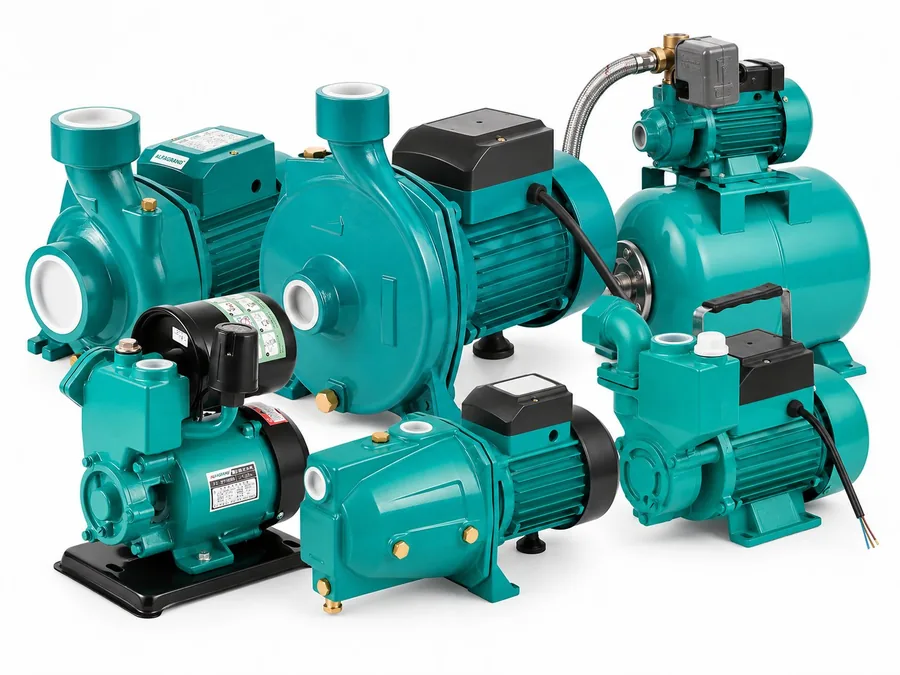
“I need a one-horsepower pump” is a common starting point. It is rarely enough to choose one. Two pumps with the same motor power can deliver very different flow at the pressure your installation actually needs.
For a useful recommendation, start with five details: what is in the water, where it comes from, how much is needed, how high it must go, and what power supply is available. A model name comes later.
1. Identify the water and the source
Clean water from a tank or municipal supply, shallow-well water, muddy drainage water and sewage are different duties. A household clean-water pump should not be offered for wastewater containing solids. Note the water temperature, visible grit, possible fibers, and whether the pump can sit below the water level. If the pump is above the source, ask about the suction arrangement and actual lift; a self-priming model still has installation limits.
2. Set the required flow
Flow is the amount of water delivered per unit of time, usually m³/h or L/min. To fill a 5 m³ tank in two hours, the average delivery target is 2.5 m³/h. For a home, consider simultaneous use rather than simply counting taps. For irrigation, ask about the number of outlets and the required flow at each outlet.
3. Work out the head at that flow
Head expresses the energy the pump must add to the water, commonly in metres. Include the elevation difference, pipe friction, bends and valves, and any pressure needed at the destination. A pump’s “maximum head” is generally measured near zero flow; it does not mean that head is available at your required flow. Check the manufacturer’s flow–head curve at your duty point.
4. Choose the pump family
| Situation | Category to investigate | Question to confirm |
|---|---|---|
| Small clean-water transfer | Peripheral or centrifugal | Required flow at operating head? |
| Irrigation or larger clean-water volume | Centrifugal | Pipe size and continuous duty? |
| Surface pump drawing from a shallow source | Self-priming jet | Actual suction lift and tightness of the suction line? |
| Flooded pit or water tank | Submersible drainage | Any solids or fibers? |
| Wastewater with solids | Sewage pump | Particle size and solids passage? |
| Groundwater from a borehole | Deep well pump | Dynamic water level and bore diameter? |
5. Check the practical details
Before ordering, confirm voltage and frequency, single- or three-phase supply, cable and plug, pipe connections, materials, control method and installation environment. For export orders, check the target market’s electrical and labeling requirements. Ask for the performance curve and the exact configuration offered, especially when one model family includes several variants.
Need help narrowing down a model?
Send your flow, elevation, pipe length, water source, voltage and order quantity to CHANGHONG’s contact page. Ask for the curve at your intended operating point.
More water pump buying guides
Technical background: Grundfos, pump sizing and curves; KSB, operating conditions.